Tjau · twenty squares
Tjau rules
Bring your seven pieces in from your hand, cross the shared lane where pieces are hit, and use the marks that throw again and keep you safe. The first to bear every piece off wins.
The original rules of senet and tjau are lost; these are modern reconstructions, and we name where each way comes from. They say exactly what the printed rules sheets in the box say.
01
The board and setup
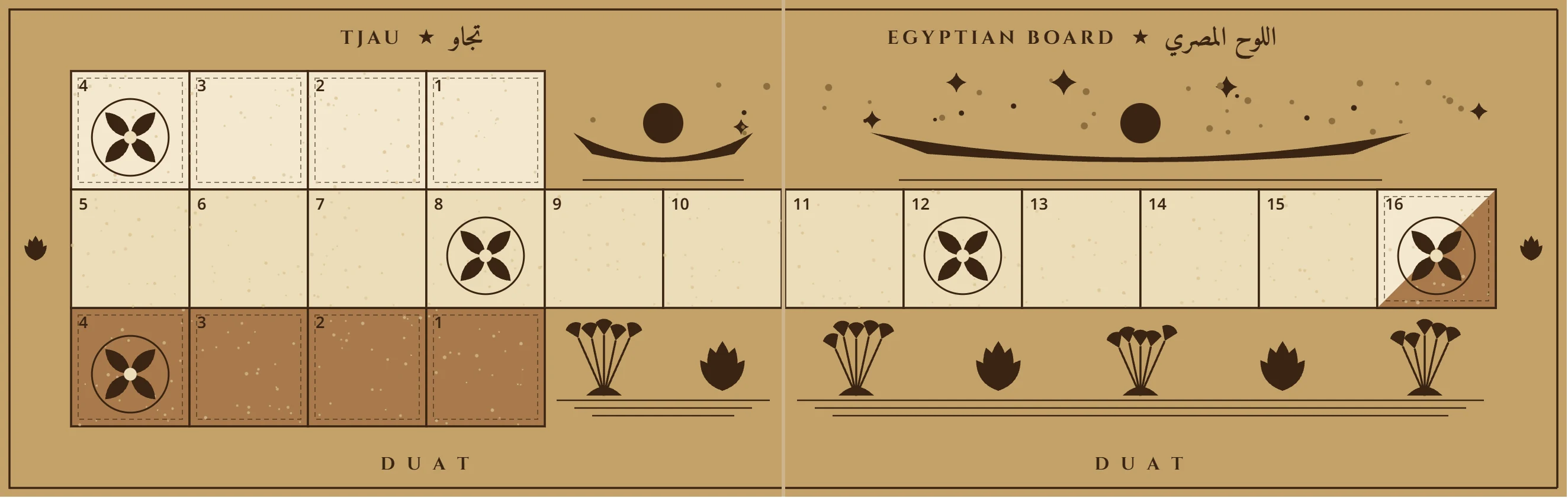
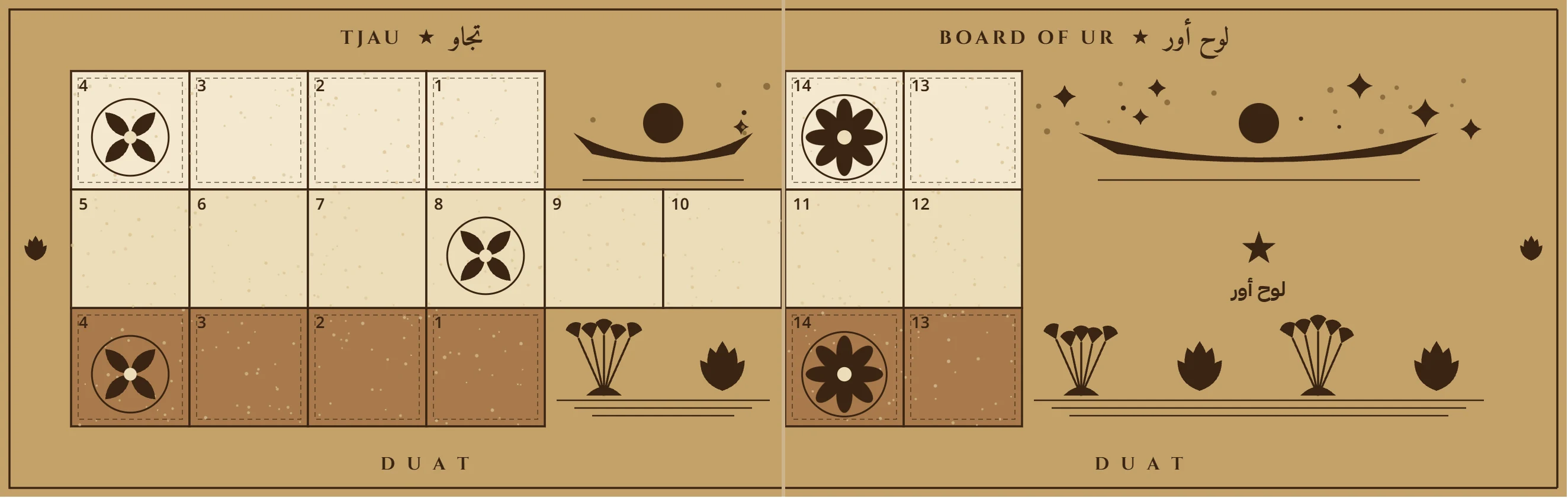
Tjau is printed on the backs of the two boards: turn the senet and ṭāb boards over and lay them side by side on their straight edges, senet’s back as half one. The ṭāb back has two ends: turn it round and the Egyptian board becomes the Board of Ur.
Each player has 7 pieces, all starting in hand off the board. The cones enter on the top row, the spools on the bottom.
Entry and exit squares wear each player’s colour.
02
The sticks
Count the light faces: 0 to 4. A zero moves nothing and the turn passes.
In tjau the sticks never throw again by themselves; extra throws come from the marks.
A 2 is the most common throw (6 in 16); a 0 and a 4 are the rarest (1 in 16).
| Throw | Of 16 | Chance | Throw again? |
|---|---|---|---|
| 0 (all dark) | 1 / 16 | 6.25% | No |
| 1 | 4 / 16 | 25% | No |
| 2 | 6 / 16 | 37.5% | No |
| 3 | 4 / 16 | 25% | No |
| 4 | 1 / 16 | 6.25% | No |
03
Entering, moving, bearing off
- Entering: the throw is the square a piece from hand enters on your row: a 3 brings it to square 3.
- The path: your row 1–4, then the shared lane 5–16.
- Marks (on 4, 8, 12 and 16): landing on one gives another throw, and a piece on it is safe.
- Hitting: only in the shared lane. A hit piece goes back to its owner’s hand.
- You may not land on your own piece.
- Bearing off: on a throw that takes the piece exactly one step past the last square.
- Winning: the first to bear off every piece wins.
04
The Board of Ur
Turn the ṭāb board round for the Board of Ur. The path is 14 squares: your row 1–4, the lane 5–12, then back on your row to 13 and 14.
Rosettes on 4, 8 and 14 work like marks: another throw, and safety.
Bear off on a throw that takes you exactly one step past 14.
05
Ways to play and where they come from
| Way | Change | Origin |
|---|---|---|
| Basic | Egyptian board, 7 pieces | The board and its marks from Tutankhamun’s boxes (Howard Carter, 1922); the route from Timothy Kendall (1982). Moving, marks and hitting come from today’s play of the Royal Game of Ur, whose boards Leonard Woolley found in the Royal Cemetery at Ur (1922–34) — not from an ancient text. |
| Babylon tablet | 5 pieces | A clay tablet written by Itti-Marduk-balāṭu in 177 BCE, published by Irving Finkel of the British Museum (2007). It names five pieces but not the route or hitting, so the rest follows the basic way. |
| Extra throw only | marks do not protect | Finkel suggests “mark = another throw” was the simpler everyday game. |
| Board of Ur | turn the ṭāb board round | The shape of the Ur boards, with the rosette on square 14 as in the common modern route. |
06
DUAT’s advice
Advice from our own play, not ancient rules.
- Sit on the mark in the middle of the lane (8): nobody can hit you there, and your opponent cannot land on it either.
- A 4 brings a piece straight onto mark 4 and throws again.
- Pieces in hand cannot be hit, but they do not move on either: do not leave many outside.
- A 2 is the most common throw: a piece in the lane two squares ahead of an enemy is in the most danger.
- Under “extra throw only” marks do not protect, so do not count on them in the lane.
Sources
The main references behind this page, as the printed rules sheets list them.
- Finkel, I. L. 2007. “On the Rules for the Royal Game of Ur.” Ancient Board Games in Perspective. British Museum Press.
- Crist, W., Dunn-Vaturi, A.-E. & de Voogt, A. 2016. Ancient Egyptians at Play. Bloomsbury.
- Griffith Institute, Oxford: Howard Carter archive, objects 345, 393, 585r, 593.
- British Museum: Royal Game of Ur BM 120834.
- The Met: game box 16.10.475; Heilbrunn essay on board games.