Eight cards, an optional modern twist for all three games, sold apart. Each has a power and a price, and they are drawn face down: nobody knows their card, not even you, until it is revealed.
The rules, powers, prices and cases are exactly as on the printed cards. “When to reveal”, “Use it when” and “Avoid it when” are DUAT’s advice from play, not rules.
The rules in full
Before the match agree: one card each or two. Shuffle the eight and draw face down; nobody looks at their card. The rest are not drawn during the match.
At the end of your turn, after all your extra throws and before the opponent’s turn, you may reveal one card only.
Once revealed: use it or decline it. It cannot be saved, and it leaves play either way.
Leave one of your turns between two reveals: reveal after your first turn, not after your second, again after your third. A turn missed as a penalty counts as the gap, but you cannot reveal in it.
Nobody reveals while another card’s power and price are still running.
A missed turn is the whole turn: no sticks, no move, no card.
If the price is impossible, the power works for free. If the power has no target, the card goes with no power and no price.
A card move earns no extra throw; landing on the water by a card still sends the piece to 15.
Going back to the start never moves a piece forward; with no room behind, it stays.
Bearing off the last piece wins at once, even by a card or a wager throw.
When to reveal a card
This is what DUAT’s computer does, tuned over 200 matches it played in each game. Advice, not a rule.
Split the match into thirds by the leader’s progress: in senet the last third begins when the leader has run about 80% of the race, in tjau about two thirds, in ṭāb when they have taken 4 pieces of 7.
First third: do not reveal at all. A card spent early buys squares nobody needed yet, and is gone for the end.
Middle third: reveal only when you are far behind.
Last third: reveal when the card really pays, or when your opponent is about to win.
Ahead at the end? Keep the card as your answer to whatever comes, unless it would settle the match at once.
You do not know the card until it is revealed, so reveal when almost any card would help — usually near the end.
A turn must pass between two reveals: holding two cards, do not wait for the very last turn.
The eight cards
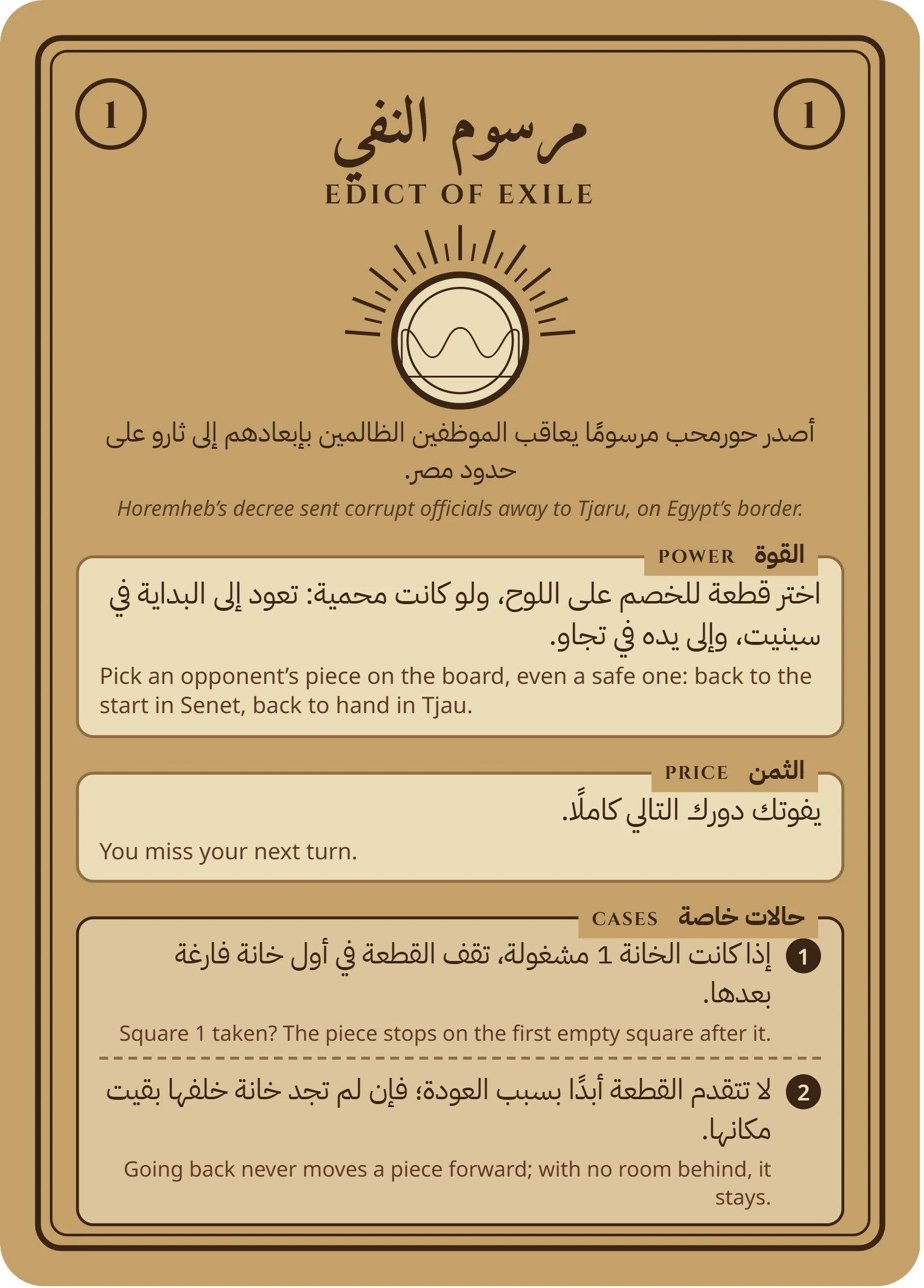
1 · 𓈉
EDICT OF EXILE
Horemheb’s decree sent corrupt officials away to Tjaru, on Egypt’s border.
Power
Pick an opponent’s piece on the board, even a safe one: back to the start in Senet, back to hand in Tjau.
Price
You miss your next turn.
Cases
Square 1 taken? The piece stops on the first empty square after it.
Going back never moves a piece forward; with no room behind, it stays.
In ṭāb: The piece goes back to its home row, locked, on the first empty square from the far end.
Use it when
An enemy piece is about to leave: on 28, 29 or 30 in senet, at the end of the lane in tjau.
In ṭāb: an enemy piece in your row is taking your locked pieces.
The last third of the match, with your opponent ahead.
Avoid it when
Early on: the piece goes back only a few squares and you lose a whole turn.
All the enemy pieces are still near the start.
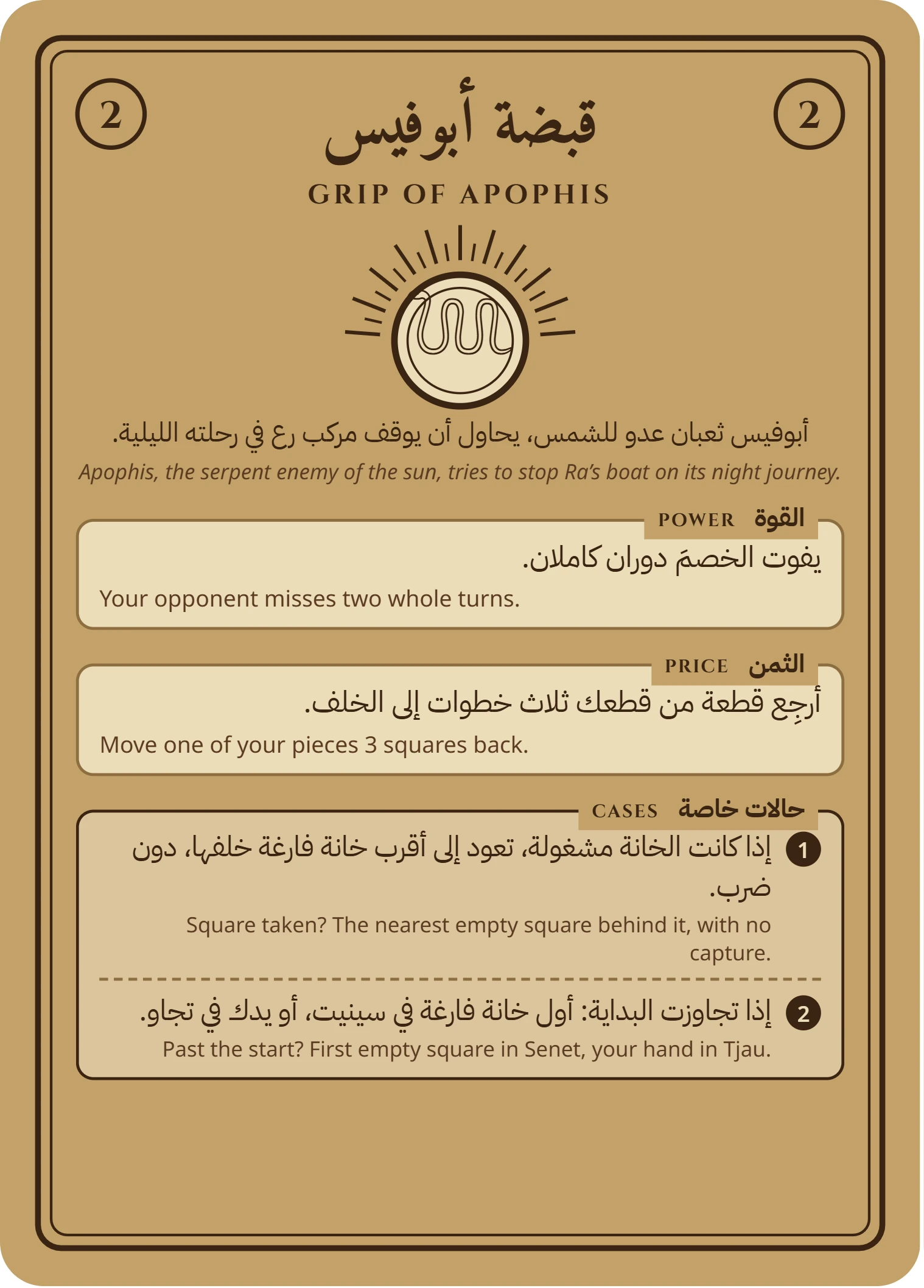
2 · 𓆙
GRIP OF APOPHIS
Apophis, the serpent enemy of the sun, tries to stop Ra’s boat on its night journey.
Power
Your opponent misses two whole turns.
Price
Move one of your pieces 3 squares back.
Cases
Square taken? The nearest empty square behind it, with no capture.
Past the start? First empty square in Senet, your hand in Tjau.
In ṭāb: The 3 squares back follow the round, and no piece goes back into its home row.
Use it when
Your opponent is about to bear off their last pieces: two turns can turn the match.
You have a piece at the back that 3 squares hardly hurt.
Avoid it when
The 3 squares back would drop your piece in the water or break a guarded pair.
Early on: two turns at the start change little.
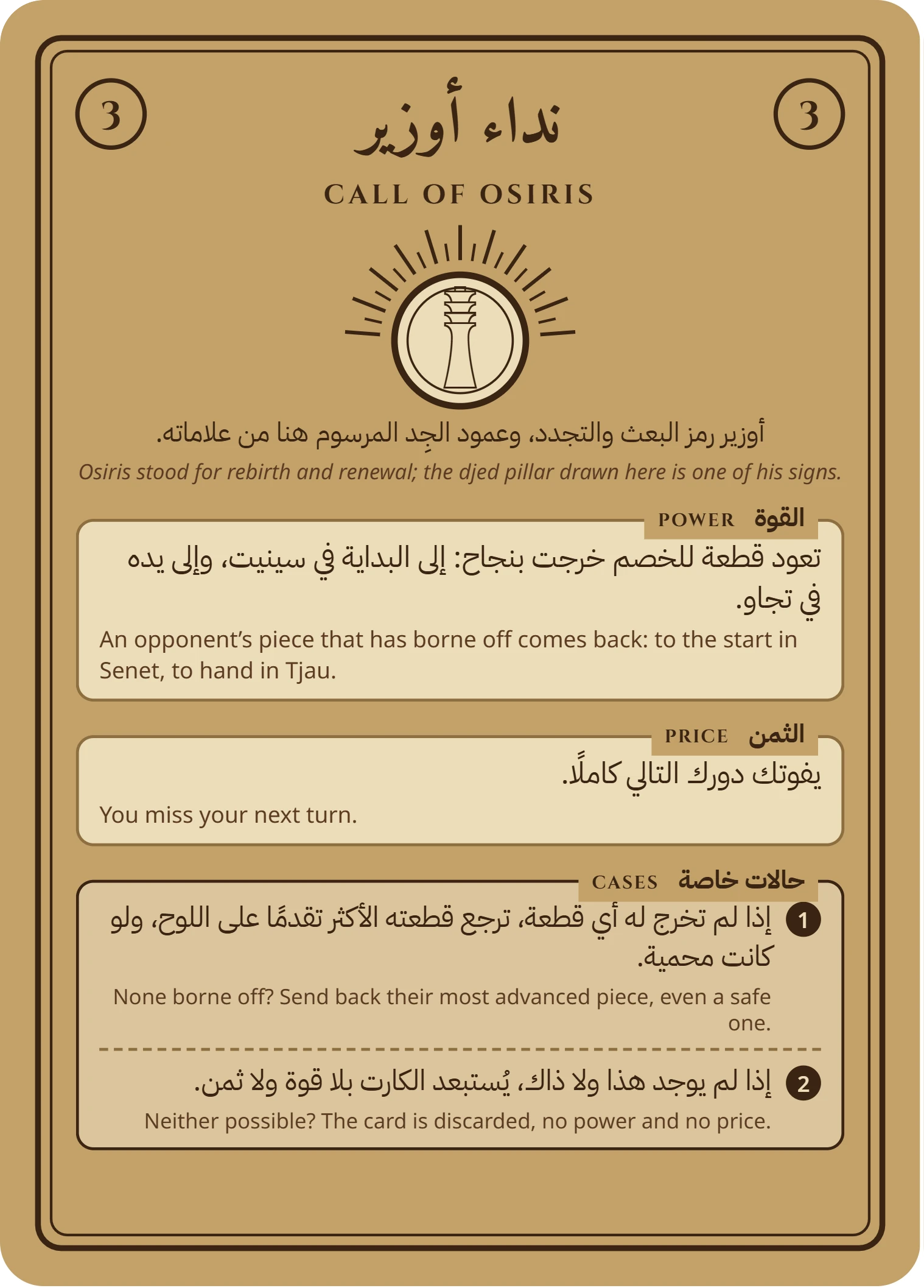
3 · 𓊽
CALL OF OSIRIS
Osiris stood for rebirth and renewal; the djed pillar drawn here is one of his signs.
Power
An opponent’s piece that has borne off comes back: to the start in Senet, to hand in Tjau.
Price
You miss your next turn.
Cases
None borne off? Send back their most advanced piece, even a safe one.
Neither possible? The card is discarded, no power and no price.
In ṭāb: Ṭāb has no bearing off, so Osiris sends back the opponent’s most advanced piece.
Use it when
Your opponent has borne off one piece or more: a piece back from the finish starts its race again.
Nothing borne off? Osiris sends back their most advanced piece, even a safe one.
Avoid it when
Early on: nothing has left yet, and the price is a whole turn.
You are close to winning: your lost turn may be the difference.
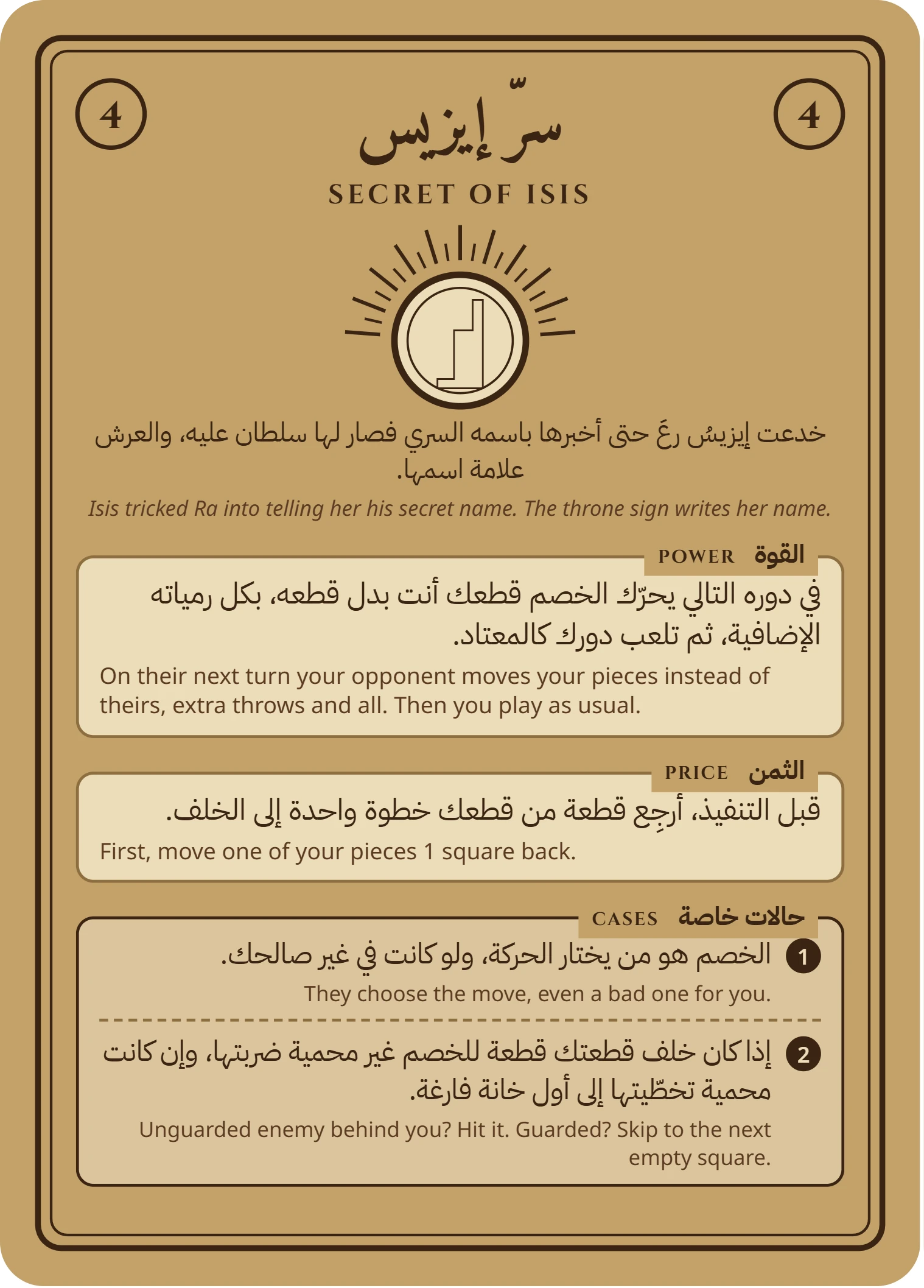
4 · 𓊨
SECRET OF ISIS
Isis tricked Ra into telling her his secret name. The throne sign writes her name.
Power
On their next turn your opponent moves your pieces instead of theirs, extra throws and all. Then you play as usual.
Price
First, move one of your pieces 1 square back.
Cases
They choose the move, even a bad one for you.
Unguarded enemy behind you? Hit it. Guarded? Skip to the next empty square.
In ṭāb: The step back follows the round, never into a home row.
Use it when
You are behind: your opponent spends their whole turn moving your pieces, so their turn is lost and you move on.
Your pieces stand where no move can hurt them.
Avoid it when
Your pieces are near the water or in front of enemy pieces: they will choose the worst move for you.
The step back would break a guarded pair or put you in front of a hit.
5 · 𓀾
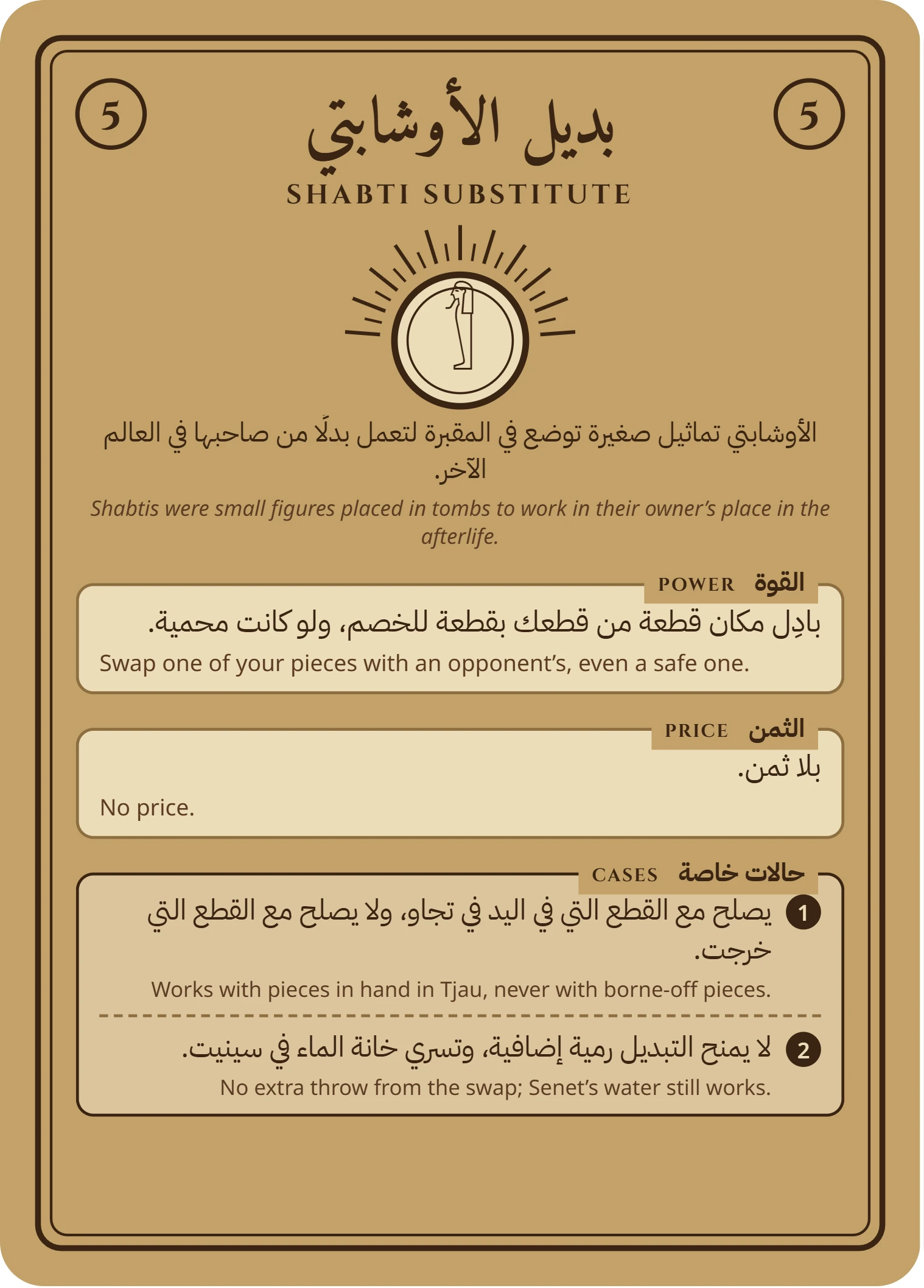
SHABTI SUBSTITUTE
Shabtis were small figures placed in tombs to work in their owner’s place in the afterlife.
Power
Swap one of your pieces with an opponent’s, even a safe one.
Price
No price.
Cases
Works with pieces in hand in Tjau, never with borne-off pieces.
No extra throw from the swap; Senet’s water still works.
In ṭāb: The swap is between two lone pieces in the middle rows.
Use it when
Your last piece is far behind and an enemy piece is about to leave: the swap turns the race, at no price.
In tjau it also works with pieces in hand.
Avoid it when
The two pieces are close together: the card buys little.
Your piece would land alone in front of enemy pieces and be hit at once.
6 · 𓋖
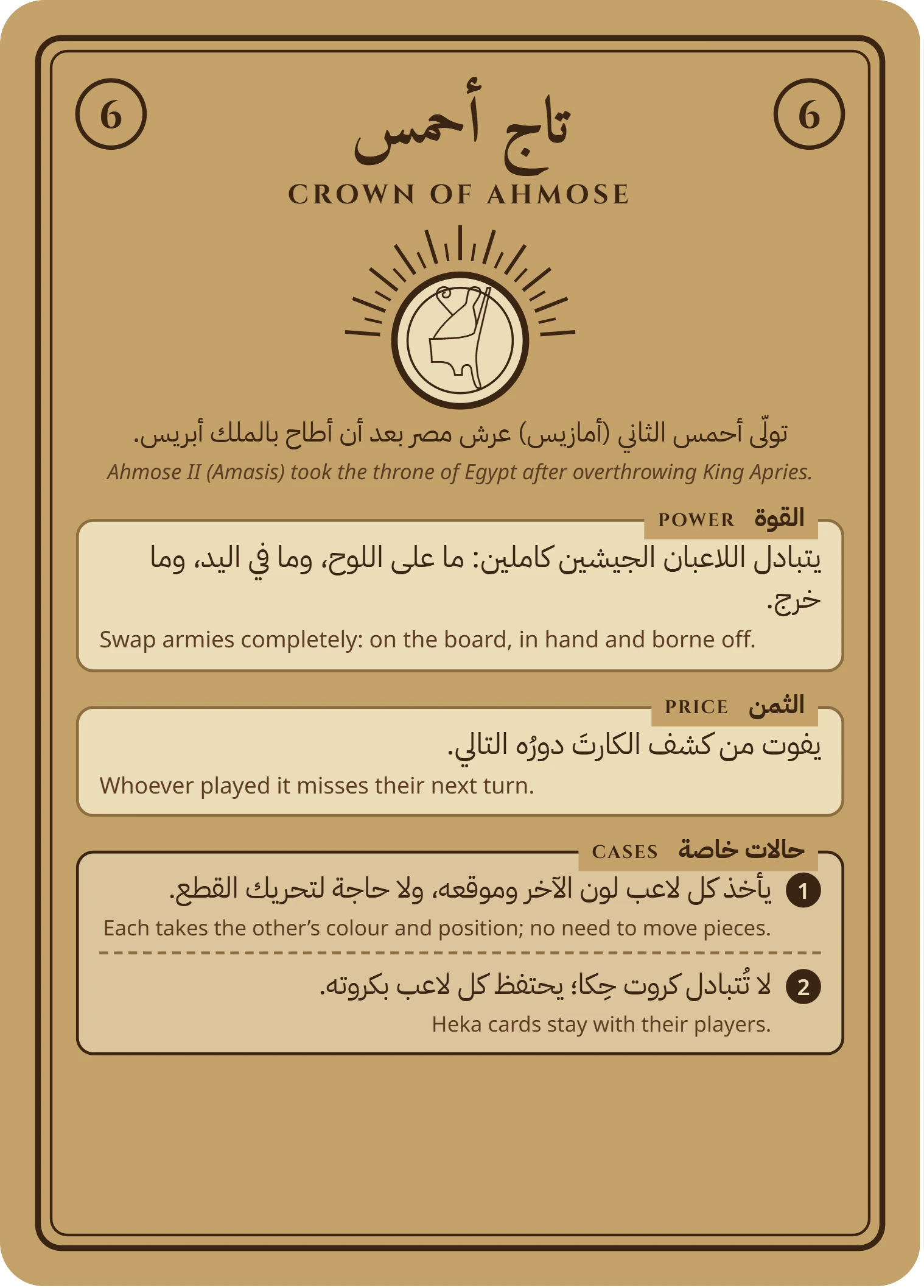
CROWN OF AHMOSE
Ahmose II (Amasis) took the throne of Egypt after overthrowing King Apries.
Power
Swap armies completely: on the board, in hand and borne off.
Price
Whoever played it misses their next turn.
Cases
Each takes the other’s colour and position; no need to move pieces.
Heka cards stay with their players.
In ṭāb: As in the other games: the two armies swap whole.
Use it when
You are far behind: you take your opponent’s whole position.
Near the end, with your opponent about to win.
Avoid it when
You are ahead: you would hand your lead over (the lesson on declining).
The gap is small: your missed turn may cancel the gain.
7 · 𓂀
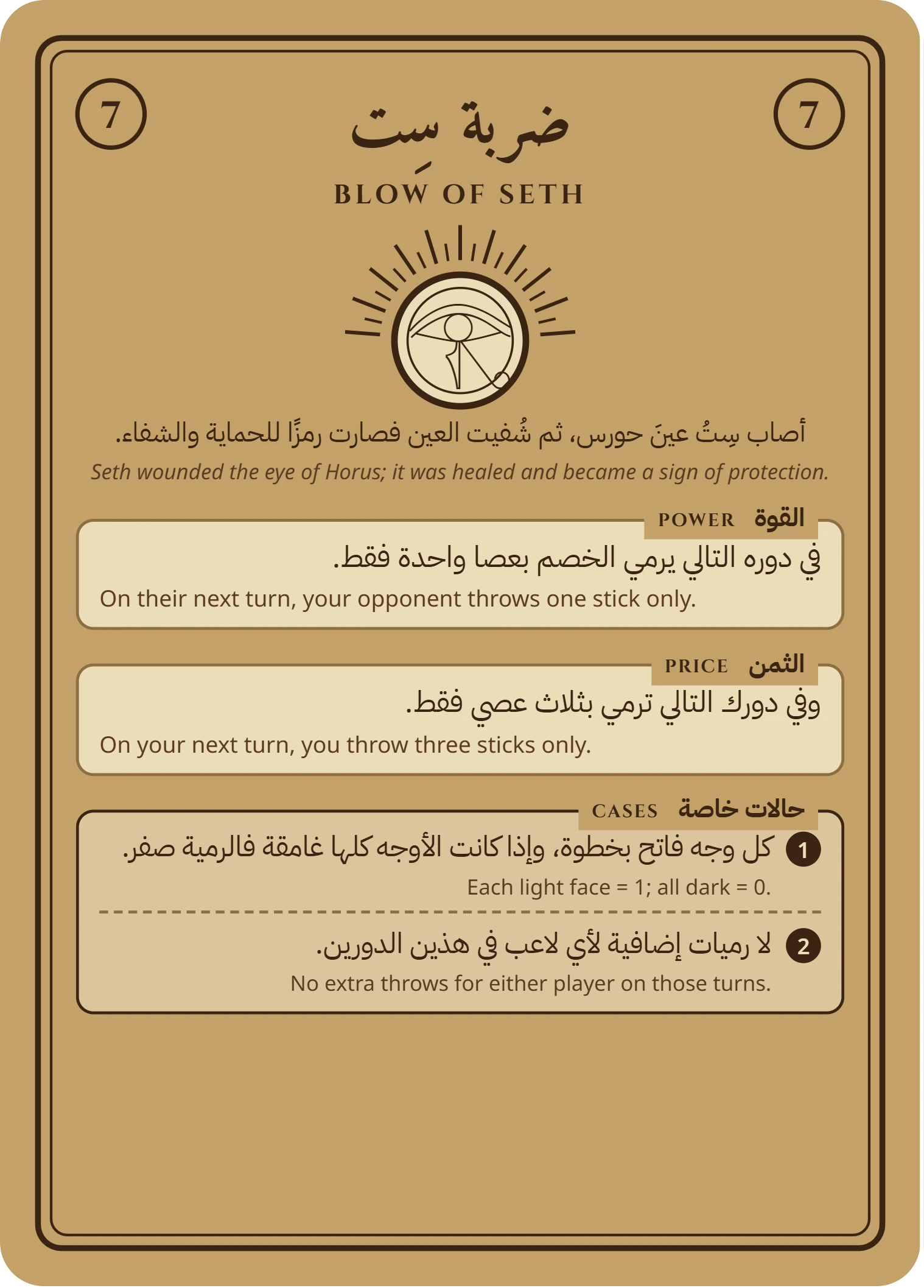
BLOW OF SETH
Seth wounded the eye of Horus; it was healed and became a sign of protection.
Power
On their next turn, your opponent throws one stick only.
Price
On your next turn, you throw three sticks only.
Cases
Each light face = 1; all dark = 0.
No extra throws for either player on those turns.
In ṭāb: One stick: light is a ṭāb (1), dark is nothing. Three sticks: count the light; all dark is nothing.
Use it when
Your opponent needs a big or exact throw to leave, such as a 5 from 26 or a 3 from 28: with one stick the most they can throw is 1.
Your own next turn matters little, so three sticks will not hurt.
Avoid it when
In ṭāb, when your opponent is waiting for a ṭāb: one stick gives them a ṭāb half the time instead of a quarter.
You need a big throw next turn: with three sticks the most is 3.
8 · 𓆄
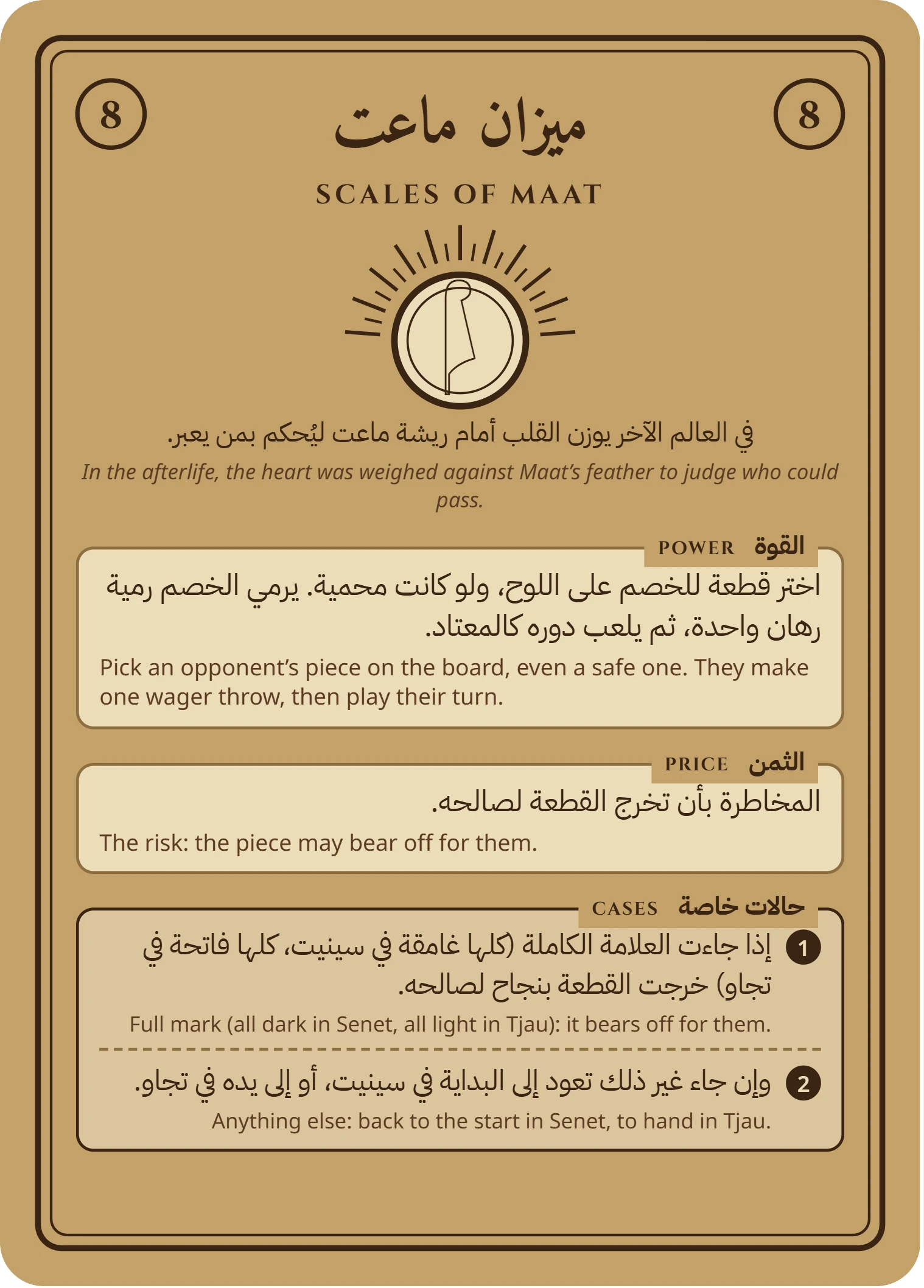
SCALES OF MAAT
In the afterlife, the heart was weighed against Maat’s feather to judge who could pass.
Power
Pick an opponent’s piece on the board, even a safe one. They make one wager throw, then play their turn.
Price
The risk: the piece may bear off for them.
Cases
Full mark (all dark in Senet, all light in Tjau): it bears off for them.
Anything else: back to the start in Senet, to hand in Tjau.
In ṭāb: The full mark is all four dark: the piece stays. Otherwise it goes home, locked.
Use it when
An enemy piece is far ahead and near the exit: 15 times in 16 it goes back to the start.
The last third of the match.
Avoid it when
It is your opponent’s last piece in senet or tjau: if the wager comes up (1 in 16) it bears off and they win at once.
Pieces still near the start: you gain little.
Sources
The main references behind this page, as the printed rules sheets list them.
Horemheb’s edict, after J. H. Breasted, Ancient Records of Egypt.
British Museum: Apophis EA 52831; Papyrus of Hunefer EA 9901.
UCL Digital Egypt: “Isis and Ra”. The Met: Osiris, shabtis, Book of the Dead spell 6, Ahmose II, Eye of Horus.