Ṭāb · a folk game of Egypt and Nubia
Ṭāb rules
Free your pieces from home with a ṭāb, go round the two middle rows, run your opponent’s row once, and take every piece they have. Whoever takes all the enemy pieces wins.
The original rules of senet and tjau are lost; these are modern reconstructions, and we name where each way comes from. They say exactly what the printed rules sheets in the box say.
01
The board and setup
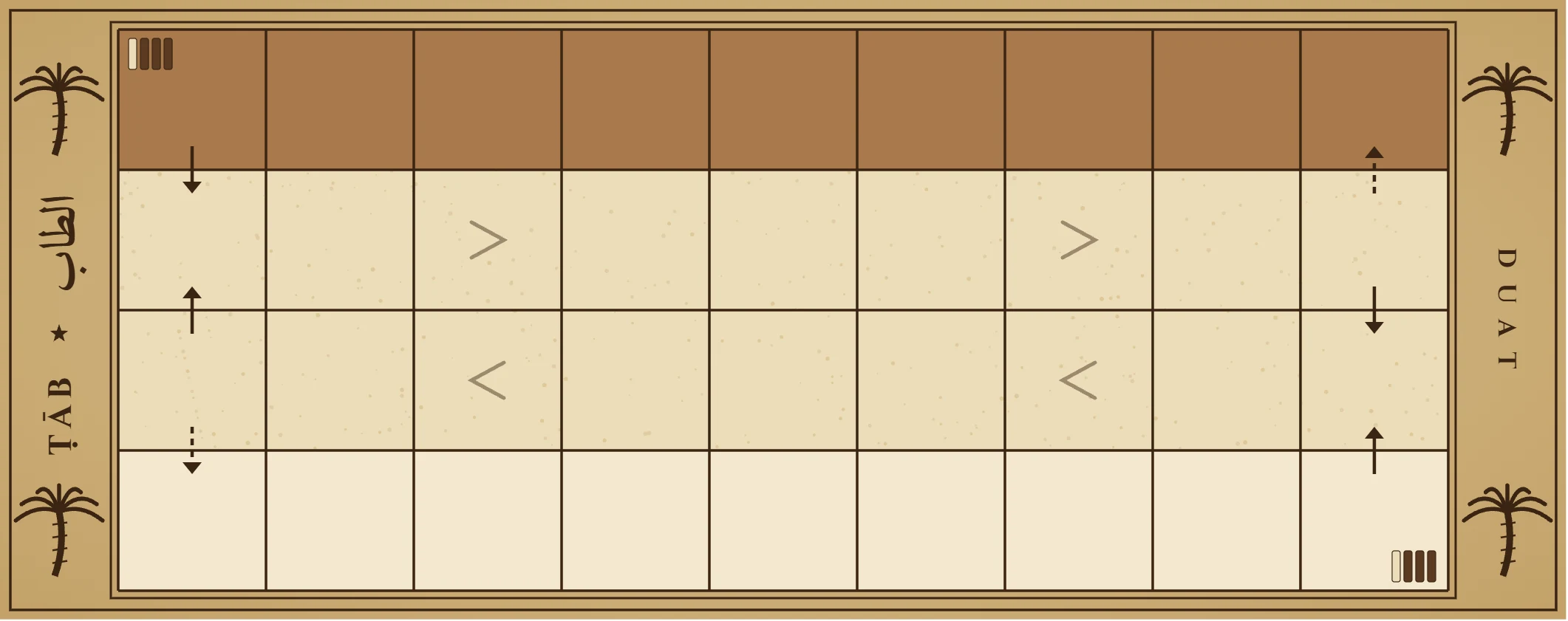
A board of four rows of nine. The row nearest you is your home, the far row your opponent’s, and the two middle rows the way for both.
Each player has 7 pieces in their home row, from the corner with the ṭāb sign. A piece still at home is locked; once out it is free.
The first to throw a ṭāb begins.
02
The sticks
Count the light (white) faces: one is a “ṭāb” and counts 1; two count 2, three 3, four 4; all four dark count 6.
A ṭāb, a 4 or a 6 throws again; a 2 or a 3 ends the turn.
A ṭāb comes up 4 times in 16, about one throw in four, so getting out of home is slow at first.
| Throw | Of 16 | Chance | Throw again? |
|---|---|---|---|
| Ṭāb (1) | 4 / 16 | 25% | Yes |
| 2 | 6 / 16 | 37.5% | No |
| 3 | 4 / 16 | 25% | No |
| 4 | 1 / 16 | 6.25% | Yes |
| 6 (all dark) | 1 / 16 | 6.25% | Yes |
03
Getting out, going round, the enemy row
- Getting out: a locked piece leaves only on a ṭāb, the corner piece first, to the square above it.
- Going round: a free piece moves with every throw round the two middle rows, following the arrows; both players go round the same way.
- The enemy row: at the end of the round, choose: round again, or up into the enemy row — once per piece, and only while enemy pieces are still in it. Run it, then rejoin the round.
- Your piece in the enemy row is safe, but cannot move on while your own row still holds locked pieces.
- Taking: land on a square with enemy pieces and take them all, locked ones in their row included.
- Every throw is played as it falls. If a move exists it must be played; if not, the throw is lost.
- Winning: take every enemy piece.
04
The ʿeggeh (Lane’s way)
- Land on your own piece and the two become an ʿeggeh that moves as one.
- Only a ṭāb splits one off: then you choose to move the whole ʿeggeh or one piece of it.
- Landing on an enemy ʿeggeh takes all of it at once.
- On the board: keep one piece on the square and the rest beside the board by that column.
- The simple way has no ʿeggeh: you may not land on your own piece.
- Freeing a piece onto your own piece on the way-out square makes an ʿeggeh at once.
- An ʿeggeh at the fork may go up into the enemy row whole, and every piece in it counts as having been up.
- A Heka card touches one piece of an ʿeggeh, never the whole of it.
05
Two ways to play
DUAT’s changes in both ways: each throw is played as it falls (Lane shares out all of a turn’s throws); a ṭāb takes the corner piece straight out; Lane’s rule shrinking an ʿeggeh that re-enters a row is left out.
| Way | Change | Origin |
|---|---|---|
| Lane’s way | with the ʿeggeh | As Edward Lane described it in Cairo (1836). |
| Simple | no ʿeggeh: you may not land on your own piece | A DUAT simplification for a first game. |
06
DUAT’s advice
Advice from our own play, not old rules.
- A ṭāb is rare (4 in 16): when one comes, weigh freeing a locked piece against moving a free one a square.
- Before you go up into the enemy row, look at your home: while it still holds locked pieces, your piece will wait up there.
- The enemy row is the best place to take from: locked pieces cannot run.
- A 2 is the most common throw: a piece two squares ahead of an enemy is in the most danger.
- In Lane’s way an ʿeggeh is quick, but if it is taken you lose everything in it at once.
07
History of ṭāb
Ṭāb is a folk game of Islamic and modern Egypt, not a pharaonic one: nothing links it to ancient Egypt.
Edward Lane set it down in detail in Cairo (1836) as very common: four palm-rib sticks, white on one face and green on the other, and a seega board of four rows, or holes in the ground. His religious names for locked and free pieces are replaced here.
Klunzinger (1878) saw boys in Upper Egypt play a ground game with the same piece names: likely ṭāb. Alex de Voogt photographed a ṭāb board on Sai Island, Sudanese Nubia (2010); its rows of holes are also identified at Petra.
It is still played in Nubia, Aswan: Masrawy (2018) reported a Ramadan tournament at El-Dakka, Nasr El-Nuba, with split palm-rib sticks.
Sources
The main references behind this page, as the printed rules sheets list them.
- Lane, E. W. 1836. An Account of the Manners and Customs of the Modern Egyptians, ch. XVII. (Project Gutenberg 70796.)
- Klunzinger, C. B. 1878. Upper Egypt: Its People and Its Products. London: Blackie.
- de Voogt, A. 2021. “Misconceptions in the History of Mancala Games: Antiquity and Ubiquity.” Board Game Studies Journal 15: 1–12.
- de Voogt, A., Hassanat, M. & Alhasanat, A. 2017, on ṭāb boards at Petra (as cited in de Voogt 2021).
- Masrawy (masrawy.com), 28 May 2018: report from Aswan by Ehab Omran on ṭāb in Nasr El-Nuba.