Senet · the game of passing
Senet rules
A race over 30 squares: bear your five pieces off the board before your opponent. On the way you hit, guard and build walls, and at the end of the path you need exactly the right throw.
The original rules of senet and tjau are lost; these are modern reconstructions, and we name where each way comes from. They say exactly what the printed rules sheets in the box say.
01
Setup
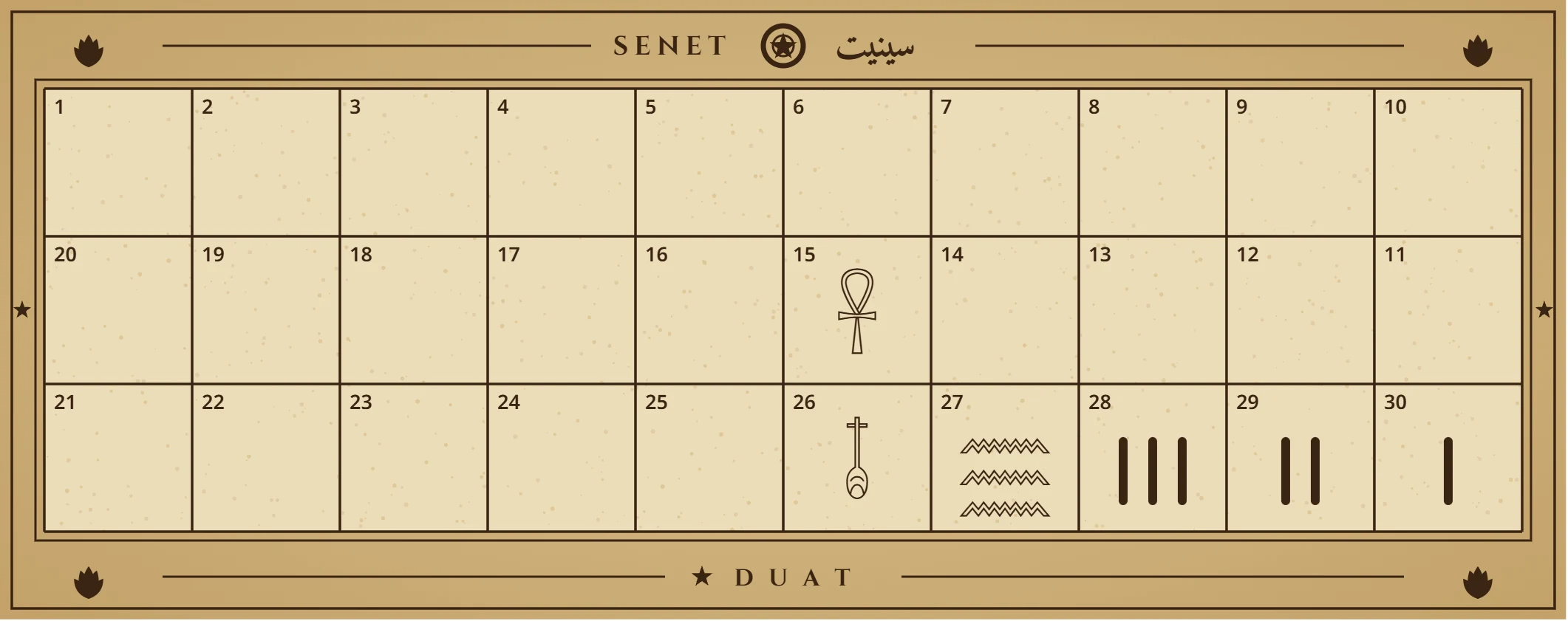
The board has three rows of ten squares. The path runs 1 to 30: the first row to the right, the second back, the third to the right again.
Each player has 5 pieces: one takes the cones, the other the spools. Set them alternately on squares 1 to 10, a cone on 1.
The cones start, or both throw and the higher starts.
02
The sticks
Throw the four sticks and count the light faces: that is how far you move. Four dark faces count 5.
Throws of 1, 4 and 5 give you another throw. The fifth stick in the box is a spare.
A 2 is the most common throw (6 in 16); a 4 and a 5 are the rarest (1 in 16 each).
| Throw | Of 16 | Chance | Throw again? |
|---|---|---|---|
| 1 | 4 / 16 | 25% | Yes |
| 2 | 6 / 16 | 37.5% | No |
| 3 | 4 / 16 | 25% | No |
| 4 | 1 / 16 | 6.25% | Yes |
| 5 (all dark) | 1 / 16 | 6.25% | Yes |
03
Moving
- Move one piece forward by the whole throw.
- If a legal move exists you must play it; if none, the turn passes.
- You may not land on your own piece.
04
Hitting, guarding, walls
- Hitting: landing on a lone enemy piece swaps you: your piece takes its square, it goes to the square you left.
- Guarding: two pieces of one player side by side guard each other and cannot be hit.
- Wall: three enemy pieces in a row cannot be passed.
- Safe squares: no piece can be hit on 26, 28, 29 or 30.
05
The end of the path, and winning
- 26, the House of Beauty: every piece must stop on it exactly; none may jump it.
- From 26: a 5 bears the piece off, a 1 drops it in the water, and 2, 3 or 4 move it to 28, 29 or 30.
- 27, the Water: a piece that falls in goes back to 15, or the first empty square before it.
- From 28 a piece leaves on an exact 3, from 29 on a 2, from 30 on a 1.
- Winning: the first to bear off every piece wins.
06
Ways to play and where they come from
| Way | Change | Origin |
|---|---|---|
| Basic | 5 pieces, all dark = 5 | Stick counting after Timothy Kendall (1978), guarding and the wall after Gustave Jéquier, the last squares’ meanings after Peter Piccione (1980). Five pieces as in Tutankhamun’s ivory box, whose drawer was found shut with five red and five white pieces (Howard Carter archive). |
| Seven pieces | 7 pieces on 1–14 | Old Kingdom scenes show seven pieces each, as in the tomb of Hesy-Re; Kendall built his rules on them. |
| Sixth throw | all dark = 6; extra throws on 1, 4, 6 | Gustave Jéquier’s reconstruction. |
| Full challenge | 7 pieces + all dark = 6 | A DUAT blend of the two changes, not any one scholar’s rules. |
07
DUAT’s advice
Advice from our own play, not ancient rules.
- Keep your pieces in pairs: a pair is guarded, and three in a row are a wall that shuts your opponent in.
- Hit the piece in front: the swap gains you as many squares as it costs your opponent.
- A 2 is the most common throw: a lone piece of yours two squares ahead of an enemy is in the most danger.
- On the House of Beauty a 1 drops you in the water (4 in 16). If you throw a 1 and another piece can move it, move that one.
- A 1, 4 or 5 carries your turn on: think of the next move before you choose.
Sources
The main references behind this page, as the printed rules sheets list them.
- Crist, W., Dunn-Vaturi, A.-E. & de Voogt, A. 2016. Ancient Egyptians at Play. Bloomsbury.
- Piccione, P. 1980. “In Search of the Meaning of Senet.” Archaeology 33: 55–58.
- Kendall, T. 1978. Passing Through the Netherworld. Kirk Game Co. (via summaries).
- Crist, W. 2021. “Debunking the Diffusion of Senet.” Board Game Studies Journal 15.
- Griffith Institute, Oxford: Howard Carter archive, objects 345, 393, 585r, 593.
- The Met: game box 16.10.475; senet of Meryma’at 01.4.1; Heilbrunn essay on board games.
- McDonald, J. K. 1996. House of Eternity: The Tomb of Nefertari. Getty.